|
|
Hi, you're in the Archives, May 2008 - Part 1 |
|
|
|
|
 |
| |
May
14, 2008 |
|
 |
| CONCERT
REVIEW by Nick Morgan |
MICK
TAYLOR'S BLUES SUMMIT |
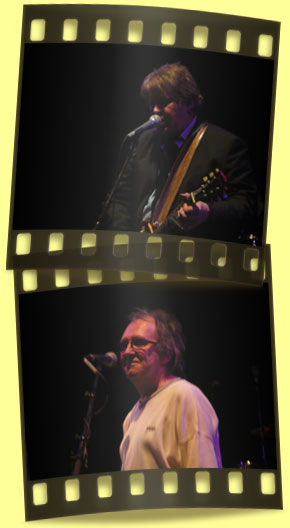
Mick
Taylor, Mitch Mitchell |
| Queen
Elizabeth Hall, London, May 5th 2008 |
| |
This
should have been a great evening.
It’s a holiday, the first
one of the year, and the weather
has been fantastic. And who wouldn’t
want to come out to see that great
blues guitarist Mick
Taylor play with a
group of musicians including Terry
Reid on guitar and vocals, the
excellent harmonica player Sugar
Blue (James Whiting), keyboard
player Max
Middleton, and drummers Collin
Allan (Stone the Crows, Zoot Money,
John Mayall etc.) and former Hendrix
mainstay Mitch
Mitchell? Starting with ‘Fed
up with the blues’ and ‘Losing
my faith’ from his second
solo album things seemed promising
enough. But as the gig continued
Taylor became increasingly disaffected,
and to be frank, apparently disinterested.
From my ringside vantage point it
appeared that the source of the
irritation was Mitch Mitchell, who
clearly doesn’t get out much,
and whose drumming was, to use a
non-technical term, “all over
the place”. Having mouthed
to Reid, “Get him off the
fucking stage” (or so it seemed
to me), |
Taylor then left himself for an
extended cigarette break, leaving
his chum Terry to hold the stage.
He did this with the verve of an
ageing music hall trooper, singing
with great gusto, but was clearly
as perplexed with events as everyone
else on the stage, except Mitchell,
who kept on coming forward to take
the microphone and tell us how happy
he was to be there. Taylor eventually
returned in a cloud of smoke and
the band stumbled on for a few more
numbers (with Mitch bashing away
in happy oblivion to the friction
he was causing), of which Bob Dylan’s
‘Blind Willie McTell’
hinted at what a great evening it
could have been. We were then treated
to an appalling encore (Ray Charles’
‘What I’d say’),
half way through which, after playing
a simply awful solo, Taylor laid
his guitar down on the stage (I
had thought he was about to plant
it on Mitchell’s head) and
left. |
I
really don’t like writing
a bad review, particularly of an
artist I admire, but you have to
tell it like it is. There’s
just no excuse for this sort of
thing. It’s unprofessional
in the extreme, and quite honestly
anyone who was there has got a right
to feel that they were severely
short-changed on the price of a
ticket. - Nick Morgan (photograph
by Kate) |
 |
TASTING
– FOUR IMPERIALS |
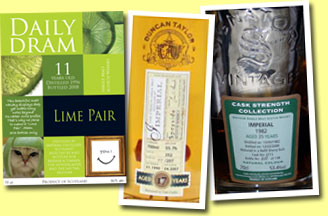
Imperial
11 yo 1996/2008 'Lime Pair' (46%,
The Nectar, Daily Dram, 303 bottles)
 Colour: white wine.
Nose: a very fresh and clean whisky,
blending notes of clean grain and
mashed potatoes with rather delicate
notes of lemon pie and fresh butter.
Simple put most pleasurable, a perfect
summer malt as far as the nose is
concerned. Mouth: sweet, clean and
fruity, more on pears this time (butter
pears) with just a slight zestiness.
Pleasant oakiness coming through after
a while, that spices up the whole.
Finish: medium long, clean and fruity,
with a little pepper. Comments: this
one reminds me of some young Bladnochs
or Rosebanks. For summertime indeed.
SGP:631 – 85 points.
Colour: white wine.
Nose: a very fresh and clean whisky,
blending notes of clean grain and
mashed potatoes with rather delicate
notes of lemon pie and fresh butter.
Simple put most pleasurable, a perfect
summer malt as far as the nose is
concerned. Mouth: sweet, clean and
fruity, more on pears this time (butter
pears) with just a slight zestiness.
Pleasant oakiness coming through after
a while, that spices up the whole.
Finish: medium long, clean and fruity,
with a little pepper. Comments: this
one reminds me of some young Bladnochs
or Rosebanks. For summertime indeed.
SGP:631 – 85 points. |
Imperial
17 yo 1990/2008 (53.1%, Duncan Taylor
Rare Auld, cask #359)  Colour: pale gold. Nose: This is much
oakier, almost plankish at first nosing.
Develops more nicely, on interesting
– albeit most unusual –
notes of green olives, warm butter
and vanilla. With water: the wood
comes out even more, as well as something
like lemongrass. Unusual indeed. Mouth
(Neat): much, much nicer than at first
nosing when neat. Rounded, slightly
candied and orangey, with the oak
giving the whole a good structure
here. Gets very spicy (wood). With
water: it’s at this stage that
it got really better. Orange marmalade
and quince jelly, baklavas, candy
sugar... Very enjoyable now. Finish:
long, sweet, candied, sligthly gingery.
Comments: a very good Imperial once
you went through the oak (using water).
SGP:551 – 83 points.
Colour: pale gold. Nose: This is much
oakier, almost plankish at first nosing.
Develops more nicely, on interesting
– albeit most unusual –
notes of green olives, warm butter
and vanilla. With water: the wood
comes out even more, as well as something
like lemongrass. Unusual indeed. Mouth
(Neat): much, much nicer than at first
nosing when neat. Rounded, slightly
candied and orangey, with the oak
giving the whole a good structure
here. Gets very spicy (wood). With
water: it’s at this stage that
it got really better. Orange marmalade
and quince jelly, baklavas, candy
sugar... Very enjoyable now. Finish:
long, sweet, candied, sligthly gingery.
Comments: a very good Imperial once
you went through the oak (using water).
SGP:551 – 83 points. |
| Imperial
17 yo 1990/2007 (53.9%, Duncan Taylor
Rare Auld, cask #353)
Colour: white wine. Nose: more austere
and restrained, much less oaky than
cask #359. Grains, ash and yellow
wild flowers. The oak comes out after
that. With water: not much changes,
maybe a little more porridge. Mouth
(neat): extremely close to cask #359,
which is normal. Maybe a tad more
lemony. With water: uber-clean now,
very fruity (tinned pineapples). Good
balance. Finish: long, clean and fruity,
with notes of pear juice and peeling.
Okay, whole pears. Comments: I like
this one a little better than cask
#359, for it’s cleaner and fruitier.
Another perfect summer malt, but not
for very hot days. SGP:642
– 84 points. |
Imperial
25 yo 1982/2008 (53.4%, Signatory,
cask #3715, refill sherry butt, 198
bottles)  Colour: dark gold – pale amber.
Nose: quite some sherry mingling with
an elegant oakiness and again notes
of warm butter. Hints of ham and sulphur.
With water: again, it’s the
wood that mostly comes out with water.
Then caramel crème, vanilla
custard and Seville oranges. Very
nice. Mouth (neat): very sweet and
very fruity, starting all on orange
drops and grenadine as well as bubblegum
and marshmallows. Again, good oakiness
behind this exuberant sweetness. With
water: something ‘lavenderish’
comes out now. Violet sweets. A little
bizarre... Finish: medium long, on
orange marmalade and lavender sweets.
Comments: unusual change of profile
with water. I like the nose better
than the palate. SGP:441 –
80 points.
Colour: dark gold – pale amber.
Nose: quite some sherry mingling with
an elegant oakiness and again notes
of warm butter. Hints of ham and sulphur.
With water: again, it’s the
wood that mostly comes out with water.
Then caramel crème, vanilla
custard and Seville oranges. Very
nice. Mouth (neat): very sweet and
very fruity, starting all on orange
drops and grenadine as well as bubblegum
and marshmallows. Again, good oakiness
behind this exuberant sweetness. With
water: something ‘lavenderish’
comes out now. Violet sweets. A little
bizarre... Finish: medium long, on
orange marmalade and lavender sweets.
Comments: unusual change of profile
with water. I like the nose better
than the palate. SGP:441 –
80 points. |
| |
May
13, 2008 |
|
|
CONCERT
REVIEW by Nick Morgan |
 |
|
Brixton
Academy, London
April 30th 2008 |
| It’s
the 30th April 2008, and thirty years
ago to the day some of us now gathered
here in a thinly-attended Brixton
Academy marched through the streets
of London with around 80,000 others
to Victoria Park in Hackney to inaugurate
the Rock
Against Racism movement. |
| The
famous Victoria Park gig (a Clash
classic) was celebrated at the weekend
by tens of thousands of people braving
the rain to attend a Love Music Hate
Racism Carnival, funded by (amongst
other people) Morrissey, who generously
stepped in at the last minute when
a major sponsor pulled out. Good old
Mozzer. You may recall RAR was inspired
by a letter written to the New Musical
Express and other papers complaining
of Eric Clapton’s racist remarks
made at a concert in Birmingham in
1976, ending with the famous postscript,
“Who shot the Sheriff Eric?
It sure as hell wasn’t you”.
A second march was held in Manchester,
with a concert headlined by the Buzzcocks
and Graham Parker (sadly our coach
dropped us off next to a too-tempting
Boddington’s pub next to the
now sadly defunct Strangeways Brewery,
so we missed the walking but managed
to get a cab to the gig). And the
rest, as they say, is history. But
tomorrow sees a nationwide election
for local government in England and
Wales, and a vote for the Mayor of
London, so this celebration of the
past is fused with thoughts for the
future. |
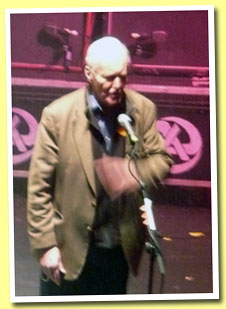
Tony Benn |
The
political bit saw a variety of speakers
brought to the microphone by MC Tom
Robinson to preach, largely if
not exclusively to the already converted
(and highly committed) about the dangers
of the extreme right. We heard various
trades union leaders, and Red Saunders,
the man who wrote that now famous
letter. But pick of the pack was veteran
campaigner, former Labour MP and Cabinet
Minister, Tony Benn. He’s getting
on a bit, and it’s perhaps not
surprising that most of his remarks
were framed in the context of his
grandchildren and his hopes for their
future and the world they would live
in. But his eyesight must be failing
him. Why else would he have ended
his speech “I have faith in
you, the younger generation, to make
this world a better place to live
in” when the average age of
the audience was 47? The speeches
came as the stage was being reset
for each band (“I’m only
on between two turns” said Benn)
– as some of them went on for
slightly longer than planned, the
musical element of the evening was
somewhat compressed. |
| It
began with Thirst,
a Brixton band championed by Robinson
on his new music radio
show, and signed by Ronnie Wood
to his Wooden
Records. It’s frenetic guitar-driven
stuff, a bit noisy and badly mixed,
but with bags of energy (as they used
to say back in 1976). And they do
sound interesting on disc, or rather
digital. They were followed by the
Levellers, who if you don’t
know are a rather dated and crusty
folk-roots punk rock band with a drizzle
of political attitude – a bit
like the Saw Doctors with a dash of
Das Kapital, or an agit-prop Status
Quo. And they’ve got the mad
bloke with the kilt and didgeridoo.
The name of course refers to the Levellers
of the English Civil War, largely
“the better class of person”
who were campaigning for greater property
and political rights for the middle-classes,
but whose ‘radicalism’
was kidnapped during the twentieth
century by a procession of left-wing
historians, most notably Christopher
Hill. But hang on, you knew all of
that stuff, didn’t you? The
music, very festival, very bouncy,
and sadly a bit lost in a half-empty
Brixton. |
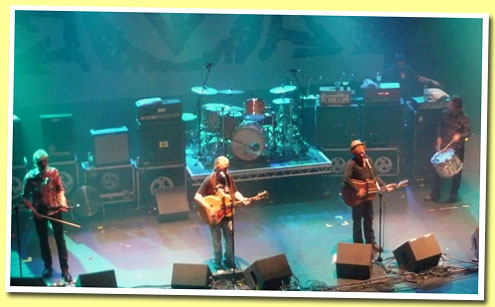 |
The
Levellers |
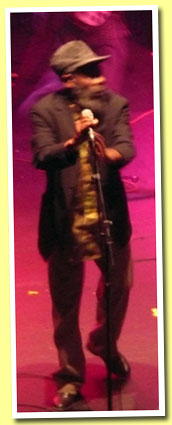
Walford Tyson |
Misty
in Roots date back to the mid
seventies, one of the great pioneers
of British reggae, along with ASWAD
and Steel Pulse. They were strongly
associated with the RAR movement and
also closely linked to the Ruts. But
whatever the band’s pedigree,
reggae can be a bit pedestrian, particularly
in a formal theatre setting. Not a
bit of it with Misty in Roots, fronted
by vocalist Walford Tyson, who managed
to fill a very large stage, backed
by very tight band and featuring some
excellent and imaginative brass arrangements.
Their songs were a mixture of African
roots, like ‘Musi-O-Tunya’,
inspired by an extensive stay the
band made in Zimbabwe and Zambia,
and pointed political comment, like
‘Cover up’, an indictment
of institutional racism. It’s
very, very, good stuff indeed. But
they were brought to an end abruptly,
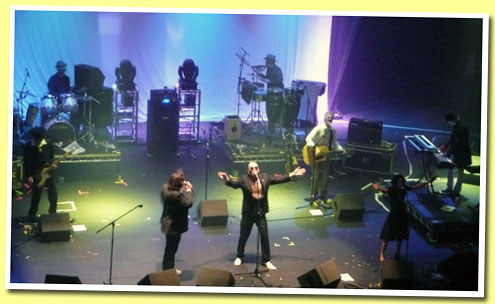
as the stage was readied for the Alabama
3, political campaigners Non Plus
Ultra. They began with ‘Mao
Tse Tung’, vocals by D Wayne
Love, and then singers Larry Love
and Devlin Love took the stage for
‘All night long’ from
the recent MOR album. Love (Larry)
had problems with his microphone for
the first four songs or so (almost
half of the set), and the sound was
something of a mess throughout. It
couldn’t even be fully retrieved
by the appearance of Mr Segs on bass.
Moreover I have to observe that Mr
Love (Larry), what with his new hair
cut and all, looked as though he’d
been overdoing it somewhat. If I was
his mother I might be worried. And
the set was clearly rushed as the
band played against the clock. So
sadly not the A3’s greatest
moment. Not really their fault. |
 |
Alabama
3 |
| Nor
perhaps was it Hope Not Hate’s.
For the record, for all the sermonising,
the following day the Labour Party
was trounced in the elections, the
extreme right British National Party
gained a seat at the London Assembly
(won in Patriot Billy Bragg’s
parish) and Labour Mayor Ken Livingstone
was ousted by Tory Boris Johnson.
It just goes to show that unlike Moses
you can’t always turn the tide.
But we enjoyed the music – particularly
the wonderful Misty in Roots. -
Nick Morgan (photographs by Kate) |
 |
TASTING
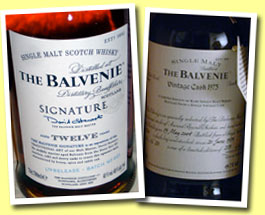
– TWO OFFICIAL BALVENIES |
Balvenie
12 yo 'Signature' (40%, OB, batch
#001, 2008)  A new limited release blending first
fill bourbon, refill and sherry casks.
Colour: full gold. Nose: rich, rounded,
almost exuberant at first nosing,
all on very ripe apricots, sultanas,
bananas flambéed and vanilla
custard and going on with the same
aromas. The sherry is discrete, that
is... Not very complicated but extremely
appealing, even sexy. Perfect balance.
Mouth: maybe just a tad weakish at
the very beginning of the attack (the
40%...) but the whisky is very ‘substantial’
so no big deal here. Develops all
on toffee (more sherry influence on
the palate than on the nose), orange
marmalade, bergamot (or earl grey
tea), quince jelly and vanilla fudge.
Very voluptuous but certainly not
lumpish or cloying. Finish: a bit
short, alas, but very clean and candied.
Comments: well, I hope there’s
a version at 43% as well out there.
Excellent work by the blenders anyways,
and a version that’s much more
appealing than the roasted/toasted/finished
young Balvenies I think. SGP:551
– 88 points.
A new limited release blending first
fill bourbon, refill and sherry casks.
Colour: full gold. Nose: rich, rounded,
almost exuberant at first nosing,
all on very ripe apricots, sultanas,
bananas flambéed and vanilla
custard and going on with the same
aromas. The sherry is discrete, that
is... Not very complicated but extremely
appealing, even sexy. Perfect balance.
Mouth: maybe just a tad weakish at
the very beginning of the attack (the
40%...) but the whisky is very ‘substantial’
so no big deal here. Develops all
on toffee (more sherry influence on
the palate than on the nose), orange
marmalade, bergamot (or earl grey
tea), quince jelly and vanilla fudge.
Very voluptuous but certainly not
lumpish or cloying. Finish: a bit
short, alas, but very clean and candied.
Comments: well, I hope there’s
a version at 43% as well out there.
Excellent work by the blenders anyways,
and a version that’s much more
appealing than the roasted/toasted/finished
young Balvenies I think. SGP:551
– 88 points. |
Balvenie
31 yo 1973/2004 (49.7%, OB, cask #9214,
213 bottles)  This older one from a first fill bourbon
barrel. Colour: pale gold. Nose: extremely
typical of the bourbon Balvenies from
the early 1970’s. Loads of ripe
apricots and vanilla crème,
‘pale’ sultanas, high-end
orange marmalade, quince jelly, then
hints of wood smoke, pine resin, eucalyptus...
All that is quite subtle and truly
superb. Unusual meatiness (ham), hints
of tinned pineapples, newly opened
pack of butterscotch... And a perfect
oak that gives the whole a superb
backbone. Classic old Balvenie, true
to its style. Mouth: exceptional creaminess
– you almost need a spoon to
get it out of your glass – and
a perfect mix of dried bananas and
pears, apricot pie, vanilla, figs,
cough syrup and various spices (cloves
ahead). And again, a perfect oak.
Finish: long, with the oak taking
control, as well as notes of cardamom
and coriander. Rather big peppery
aftertaste, with something pleasantly
prickly. Comments: good good good.
And classic. SGP:651 –
91 points.
This older one from a first fill bourbon
barrel. Colour: pale gold. Nose: extremely
typical of the bourbon Balvenies from
the early 1970’s. Loads of ripe
apricots and vanilla crème,
‘pale’ sultanas, high-end
orange marmalade, quince jelly, then
hints of wood smoke, pine resin, eucalyptus...
All that is quite subtle and truly
superb. Unusual meatiness (ham), hints
of tinned pineapples, newly opened
pack of butterscotch... And a perfect
oak that gives the whole a superb
backbone. Classic old Balvenie, true
to its style. Mouth: exceptional creaminess
– you almost need a spoon to
get it out of your glass – and
a perfect mix of dried bananas and
pears, apricot pie, vanilla, figs,
cough syrup and various spices (cloves
ahead). And again, a perfect oak.
Finish: long, with the oak taking
control, as well as notes of cardamom
and coriander. Rather big peppery
aftertaste, with something pleasantly
prickly. Comments: good good good.
And classic. SGP:651 –
91 points. |
| |
May
12, 2008 |
|
|
 |
TASTING
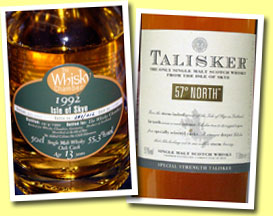
– TWO YOUNG TALISKERS |
| Isle
of Skye 13 yo 1992/2005 (55.3%, The
Whisky Chamber, cask #3196, 312 bottles,
50cl)
A small German bottler. Colour: white
wine – straw. Nose: far from
a peaty and peppery blast, rather
someting porridgy, yoghurty and lemony,
even if the peatiness does slowly
arise after a while. Not much dimension,
but water should help here. With water:
well, water closed it down. Lemon-sprinkled
porridge. Mouth (neat): this one starts
much better on the palate than on
the nose. Probably a tad simple but
beautifully sharp and lemony, hyper-zesty
and candied. Peated lemon pie? With
water: rounder, creamier, candied,
orangey and very, very drinkable.
Simplicity at its best on the palate.
Finish: rather long, more ‘Talisker’
now, with the pepper starting to strike
once you’ve swallowed everything.
Comments: huge contrast between a
discrete nose and a rather demonstrative
palate. Good anyway. SGP:246
– 86 points. |
| Talisker
'57° North' (57%, OB, 2008, 1
litre)
A recent version for duty free shops
only, that one can find in several
Internet shops as well, as often with
‘interesting’ new bottlings.
Colour: full gold. Nose: it is a bigger
whisky indeed, but it’s still
no wham-bam Talisker at first nosing.
The good news is that things keep
improving after a good fifteen seconds,
with kind of a lemony peatiness growing
bigger and bigger. Little pepper,
that is. With water: it got sharper
and more lemony, mineral, flinty,
peppery, with maybe just hints of
seaweed (ah, advertising!) Mouth (neat):
really thick, creamy, it makes me
think of something like peppered lemon
tree honey mixed with kumquats (sorry
if you’re fed up with my crappy
culinary analogies.) Directly enjoyable.
With water: the pepper strikes earlier
than in the 1992! Big, big peppery
blast that almost kills all other
flavours. Finish: long and, you guessed
it, very peppery. Comments: a two-faced
Talisker, rather rounded and relatively
gentle when naked but almost monstrous
when watered down. Two whiskies for
the price of one, why would we complain?
SGP:357 – 88 points. |
| MUSIC
– Recommended listening.
Are ethics always other people's ethics?
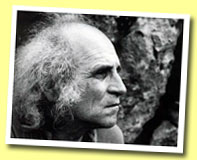
The free thinking Leo
Ferré gives the
answer in his famous Préface.mp3.
Early slam? Please buy the great Léo's
music and poetry. |
 |
| |
May
11, 2008 |
|
|
CONCERT
REVIEW by Nick Morgan
EDWYN COLLINS
Shepherds Bush Empire, London, April
29th 2008 |
| Edwyn
Collins is famous for
a number of things: that voice, one
of the most strangely soulful in British
music; a sometime questionable taste
in haircuts and knitwear (and I’m
not sure about the mustard coloured
shoes he’s sporting tonight);
being at the forefront of the musical
renaissance that sprung out of Glasgow
in 1980 with Orange Juice and Postcard
Records; his 1994 global hit single
‘A girl like you’; and
the fact that in February 2005 he
suffered two brain haemorrhages, underwent
major surgery and emerged alive, but
speechless and without the use of
much of his right side. And thinking
about it, he should also be famous
for the fact that just over three
years on he’s here on the stage
at the Shepherds Bush Empire, playing
with his band to a sadly only half-full
house of very loving fans. If the
rest have written him off then they’ve
made a big mistake. |
| Since
his illness, Collins has released
a new album (that he’d just
finished recording before his two
strokes) and last year performed a
handful of gigs in London. Now he’s
back on a short UK tour. He’s
worked hard to get back the power
of speech, and the ability to sing.
His voice still with that unique resonating
bassano boom but when he speaks he’s
slower and more deliberate than his
former eloquent self. But he has a
lot to say – telling us about
the strokes, about learning to sing
again, about trying to remember his
songs – all of which is punctuated
by an infectious deep laughter. |
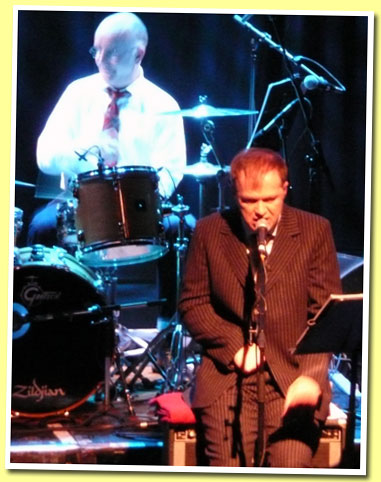
Dave Ruffy and Edwyn Collins
|
| And
when he does sing it’s the same
Edwyn Collins voice, sometimes a little
flat (but wasn’t he always?)
and occasionally hesitant over some
of the more complex lyrics. Apart
from that it’s the real thing
– no sympathy votes here at
all, please. And behind him is a band
that will not let him fail. Unless
I’m mistaken, it includes Dave
Ruffy (ex Ruts) on the drums, Andy
Hackett (as well known for selling
guitars as playing them) on guitar,
Carwyn Ellis on bass, Sean Read on
keyboards (both long-time Collins
collaborators), and fronting the outfit
Roddy
Frame on electric and acoustic
guitars and banjo. Frame and Collins
are very close and old friends, but
even so Frame excels himself in everything
he does – I’ve rarely
seen a guitarist play through a set
like he does. |
|
Roddy
Frame and Edwyn Collins |
|
The set begins with ‘Falling
and laughing’, ‘Poor old
soul’ and ‘What presence’,
a trio of Orange Juice heavyweights,
before turning to Collins’ solo
work with songs from the new album,
‘Home again’, One is a
lonely number’, ‘You’ll
never know (my love)’ (with
guest vocals from Luca Santucci),
‘One track mind’ with
older tunes like ‘Make me feel
again’ and ‘The Wheels
of love’. We got, of course
‘Rip it up’, and the set
ended with a rampant ‘A girl
like you’ with a simply stunning
Frame solo. The band promptly left
the stage, leaving Collins with his
audience. Slowly and deliberately,
with the help of his wife, Grace,
he made his way off to the right of
the stage, pausing just once to look
back. Of course there’s an encore,
Collins with Frame on guitar singing
a new composition, ‘Searching
for the truth’, which could
have had everyone in tears, and then
with the band ‘Blue boy’
and finally ‘Don’t shilly
shally’. But before that final
song, the crowd are shouting and one
voice catches Collin’s attention.
He looks earnest, frustrated –
“I’m sorry. I’m
really sorry, but I don’t remember
that song. It’s so difficult
for me to remember …”
It’s a painful narrative which
earns a huge ovation, at the end of
which Frame menacingly leans forward
searching for the voice in the crowd
– “That’ll teach
you to ask for a song, you heartless
bastard”. |
| But
like everything else it’s good
humoured, and what couldn’t
be when Collins’ mischievous
laughter drives the set on? So, alone
on stage, he again makes that difficult
walk, arm in arm with his wife, and
again stops and turns to look back,
almost quizzically, at the cheering
crowd. That’s one rock and roll
picture I’ll remember for ever.
- Nick Morgan (photographs by
Kate) |
 |
TASTING
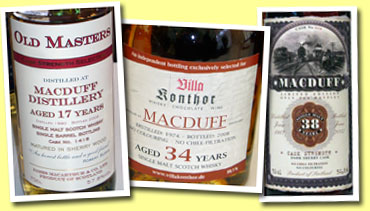
THREE MACDUFFS |
Macduff
17 yo 1990/2008 (57.8%, James MacArthur,
sherry, cask #1418)  Colour: white wine – straw.
Nose: cheese galore! And yoghurt,
muesli, porridge... Doesn’t
quite smells like gym socks but...
After all, some may like this kind
of profile, but I’m afraid I
don’t. With water: cooked cabbage
and asparagus, then plain cheese again
(Stilton?). Probably flawed. Mouth
(neat): sugary and then twisted. No
more cheese, rather ‘old porridge’
and grapefruits. Drinkable but barely...
With water: okay-ish now, on orange
drops. Finish: rather long, cleaner
and sweeter. Oranges. Comments: bacteriologic?
An exception within James MacArthur’s
latest range, which we find globally
very good. SGP:331
(no indices for cheesiness, sorry)
– 55 points.
Colour: white wine – straw.
Nose: cheese galore! And yoghurt,
muesli, porridge... Doesn’t
quite smells like gym socks but...
After all, some may like this kind
of profile, but I’m afraid I
don’t. With water: cooked cabbage
and asparagus, then plain cheese again
(Stilton?). Probably flawed. Mouth
(neat): sugary and then twisted. No
more cheese, rather ‘old porridge’
and grapefruits. Drinkable but barely...
With water: okay-ish now, on orange
drops. Finish: rather long, cleaner
and sweeter. Oranges. Comments: bacteriologic?
An exception within James MacArthur’s
latest range, which we find globally
very good. SGP:331
(no indices for cheesiness, sorry)
– 55 points. |
| Macduff
34 yo 1974/2008 (59.4%, Villa Konthor
Limburg)
Colour: gold. Nose: much less expressive
than the 1990 but that’s rather
good news. Takes off slowly, on oranges
and ginger tonic, grass, wet wood
and vanilla, but water may be needed.
So, with water: now we have hyper-heavy
whiffs of fresh mint and lemon balm.
Very nice! Mouth (neat): sweet, very
nervous, extremely lemony, grassy
and resinous. Lemon zests, lime, mint,
sorrel... Then oak and pepper, cloves...
Big zing at 34 years of age. With
water: amazing how it got hugely drinkable
now, on all sorts of herb liqueurs
(Bénédictine, Chartreuse,
Verveine) and even something that
reminds me a of good mojito. Finish:
rather long, clean, balanced, zesty.
Comments: another oldie that needs
water, but then it gets pretty beautiful.
Unusual zestiness at 34 years old.
SGP:451 – 86 points. |
| Macduff
38 yo 1967/2005 (50.8%, Jack Wieber,
Old Train, cask #619, 204 bottles)
Colour: amber. Nose: this one comes
from another world, full of oranges,
milk chocolate, quinces, ripe mangos
and even pomegranates. Then we have
Havana smoke, wood smoke, dried mushrooms,
old Parma ham, leather... Very complex
yet ‘full’, rather entrancing.
And the whiffs of old rancio and very
old cognac are beautiful as well.
An exceptional nose, let’s not
take chances with water. Mouth: the
most balanced of sherried whiskies,
dry and flavourful at the same time.
All things orangey first, then walnuts
and cigar tobacco, morels (yummie),
strong black tea... Gets then more
citrusy (more oranges, lemons) and
finally frankly fruity (ripe strawberries).
Quite some oak ‘of course’
but it’s constantly an asset
here. Finish: not too long and drier
at this point (grape skin, old armagnac.)
Comments: a tireless old Macduff with
something ‘antique’ but
also an excellent freshness. SGP:354
– 91 points. |
| |
May
10, 2008 |
|
|
FEIS
ISLE 2008: TWO NEW SINGLE CASKS |
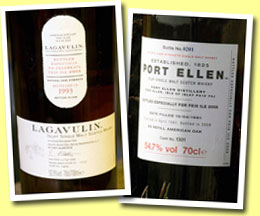
Right: Port Ellen 1981 'Feis
Isle 2008':
the first-ever official single
cask bottling,
25 years after the closure. |
| After
Laphroaig who fired first with their
'Cairdeas' (which is already for sale
on the distillery's website), it's
Diageo who announces not one, but
two 'Feis Isle Special' bottlings,
namely a Lagavulin 1993 Single Cask
like last year (picture, left), fairly
priced at £59, and a first,
a Port Ellen 1981, single cask as
well, priced at £99.99. Hope
they'll have 1 penny change at Caol
Ila, where it'll be available in exclusivity
on May 26 - (not at the Maltings.)
There will be only +/- 200 bottles
of the PE. |
 |
TASTING
– TWO 1965 TOMATINS BY DUNCAN
TAYLOR |
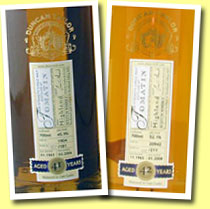
| Tomatin
41 yo 1965/2006 (45.9%, Duncan Taylor
Rare Auld, cask #1904, 181 bottles)
Another two fruitbombs? Let’s
see... Colour: gold. Nose: well, it’s
well creamy, soft and fruity as expected,
albeit not quite exuberant. Quinces
and oranges, kumquats, vanilla crème,
bananas (not big bananas)... All that
coated with subtle notes of nutmeg
and a little cinnamon. Excellent freshness
considering its age. Mouth: sweet
and fruity attack, quite soft, on
orange drops and tinned pineapples.
The oak and its spicy cortege strikes
second, making the whole rather drier.
Strong tea and grape pips. Finish:
rather long but maybe a tad too drying
now. Quite some cloves. Comments:
a very good old Tomatin, especially
on the nose, but maybe it was better
a few years ago. Maybe the spirit
isn’t big enough to stand a
rather active cask for so long. SGP:450
– 84 points. |
| Tomatin
42 yo 1965/2008 (52.1%, Duncan Taylor
Rare Auld, cask #20942, 211 bottles)
Colour: gold. Nose: this cask is quite
different, staring more austerely,
on whiffs of fresh mint and apple
juice, but growing bigger and bigger
over time. Acacia honey, apricots,
quinces, oranges, hints of bergamot...
All that is very subtle, very elegant.
Rather big notes of eucalyptus after
a moment, that is, and pine resin.
A very complex old Tomatin. Mouth:
bolder and punchier than cask #1904,
with a spirit that seems to better
stand the rather big oakiness. Many
fruits (please see above) and quite
some spices. Excellent notes of ‘clean’
ginger as well. Finish: long and balanced,
between the fruits and the oak. Comments:
the palate is punchier and less complex
than the nose but the overall quality
is quite huge. Half a fruitbomb. SGP:540
– 89 points. |
| MUSIC
– Recommended listening.
The wonderful and adventurous jazz
pianist Marilyn
Crispell plays Annette
Peacock's Open,
to love.mp3 with no less than
Gary Peacock and Paul Motian, which
is almost a seal of quality. Please
buy Marilyn Crispell's music. |
 |
| |
May
9, 2008 |
|
|
 |
TASTING
THREE
NEW CAOL ILAS |
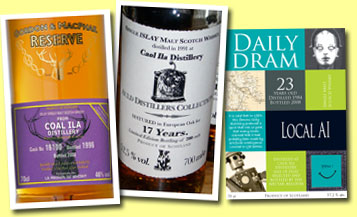
| Caol
Ila 1996/2008 (46%, Gordon & MacPhail
Reserve for LMdW, cask #16100)
Colour: white wine. Nose: as fresh
and clean as a young Caol Ila can
get. Touches of dill and fresh butter,
then mint and liquorice sticks, the
whole coated with whiffs of sea air.
Flawless but maybe not overly expressive.
Mouth: starts all on gentian –
which we love – and liquorice,
truly earthy. The peat is big and
so are the spices, pepper first. Little
salt here, a Coal Ila from the land
rather than from the sea on the palate.
Also a little ashy. Very good anyway...
Finish: pretty long, balanced, mid-punchy
mid-civilised, back on dill and with
a little salt now. Comments: of course
it’s very good whisky. SGP:337
– 86 points. (and
thank you, Olivier) |
| Caol
Ila 17 yo 1991 (52.5%, Jack Wieber,
Auld Distillers, 200 bottles, 2008)
Colour: gold. Nose: this one is more
buttery and vanilled at first nosing,
but the overall profile isn’t
too different. Maybe a tad more medicinal
as well as a little smokier. Very
medicinal, actually, as after a few
minutes it really smells like a young
Laphroaig. Great nose I must say.
Also notes of unlit Havana cigar,
quite wild. Mouth: this Caol Ila definitely
doesn’t taste like Caol Ila.
Wilder, rougher, very earthy and very
grassy (rocket salad), with green
tannins (a pleasure in this case)
and notes of verjuice. It’s
only after this, err, ‘green’
display that more typical notes do
appear, such as salt, peat, pepper
and a rather big smokiness. Finish:
long, still very pleasantly ‘green’,
with obvious tannins that add even
more wildness to the whole. Comments:
an unusually rough Caol Ila and a
very interesting variant. SGP:157
– 88 points. |
| Caol
Ila 23 yo 1984/2008 'Local AI' (57.2%,
The Nectar, Daily Dram, 198 bottles)
Colour: white wine. Nose: a little
more wood influence (read vanilla)
here but other than that it’s
really like the 1996, only with more
ageing. Gets more complex after a
few minutes, though, with more iodine
and more dill, mint and aniseed. Or
make that fennel. Very pleasant ashy
notes as well, a little wet chalk...
It’s only after ten good minutes
that it really takes off, that is,
getting very farmy and maritime at
the same time, all that along some
beautiful notes of marzipan and putty.
This one needs time! With water: this
is funny, now it got fully coastal.
Sea air, shells, iodine, fisherman’s
net and bikinis. Not bikinis. Mouth
(neat): it’s like the official
18yo, only at cask strength. Enough
said. With water: a middle-aged Caol
Ila in its full glory. Almonds, clams,
salt, peat, pepper and crystallised
lemons. Totally classic. Finish: long,
with more pepper and peat and less
of the rest. Comments: another one
that one shouldn’t try to assess
too quickly, but then it really delivers.
Beautiful. SGP:346 –
90 points. |
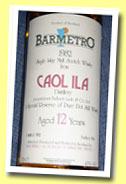
| And
also Caol
Ila 12 yo 1982/1994 (43%, Taverna
degli Artisti for Bar Metro)
A soft, mildly smoky and rather earthy
Caol Ila with very good balance and
very pleasant notes of Williams pears.
Very, very drinkable. SGP:425
– 84 points. |
 |
| MUSIC
– Recommended listening.
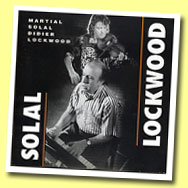
French pianist Martial
Solal and violonist Didier
Lockwood play a luminous
Miss
Copeland.mp3 (it's on the CD called
'Solal Lockwood'). Please buy these
wonderful persons' music! |
 |
| |
May
8, 2008 |
|
|
 |
TASTING
– THE PERFECT STRIKE: FOUR
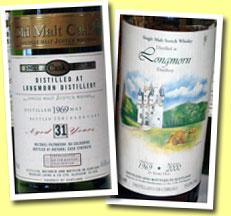
1969 LONGMORNS |
| Longmorn
31 yo 1969/2001 (45.65%, Douglas Laing
OMC, 210 bottles)
Colour: pale gold. Nose: this one
isn’t one of these ‘usual’
old uber-fruity Longmorns it seems.
Starts rather meaty (smoked ham, sausages)
as well as quite herbal (jasmine tea,
patchouli, dried parsley), displaying
rather big – and unusual again
– notes of clams and oysters.
Even crabs. Also saffron and soft
paprika... Thai whisky? Very, very
impressive anyway, and unlike any
other malt whisky I could nose up
to now. Yes, even the dreadful Mekong
whisky... Mouth: just a marvellous
basket of all kinds of citrus fruits
this time, at least at the attack.
Oranges, lemons, tangerines, kumquats
(you name them)... Then we have the
oak and its spices, very ‘ethereal’
ones, plus a little coriander and
pinches of salt. Amazing how nose
and palate are different in this one,
it’s almost like if we had two
(beautiful) whiskies. Finish: long,
all on orange and lemon marmalade
plus salt. Comments: this old Longmorn
is really fun – and two whiskies
for the price of one! SGP:463
on the nose and 732
on the palate– 91 points. |
| Longmorn
1969/2000 (53.8%, Castle Collection,
VA.MA., Italy)
Colour: gold. Nose: hell, this is
superb again! Starts much more on
milk chocolate and crystallised oranges
as well as a little mint but gets
then very, very fruity, which is ‘normal’
now. Well. Exceptional notes of tropical
fruits (papayas and mangos ahead),
then the same kind of meatiness as
in the DL, only milder. Then whiffs
of old walnuts and orange juice, lemon
balm, thuja wood, plum sauce... Truly
wonderful. No water needed. Mouth:
it’s almost like jam! Lemon
marmalade, lemon honey, quince jelly,
yellow plums, ripe apricots... And
more honey and oranges. Also tobacco,
white pepper, Szechuan pepper, cloves...
Wonderful again. Finish: long, coating,
candied, orangey and honeyed. Comments:
another wonderful old Longmorn, globally
more classic than the DL but not less
good. SGP:743 – 91 points. |
| Longmorn
1969/2008 (54.6%, Gordon & MacPhail
Cask for The Whisky Fair)
This one caught a lot of attention
at the latest Whisky Fair in Limburg.
Colour: full gold. Nose: a little
more discrete at first nosing, almost
shy, which is unusual with old Longmorns.
Takes off after a good two minutes,
that is, slowly but continuously.
First we have the same notes of lemon
balm as in the ‘Castle’,
then orangey notes that grow bigger
and bigger, then mango, guavas, verbena,
even a little muscat grape... All
that is coated with wood smoke (or
pine cones), mint and even a little
eucalyptus, and the whole is probably
less decadent than its siblings but
just as beautiful on the nose. No
water needed. |
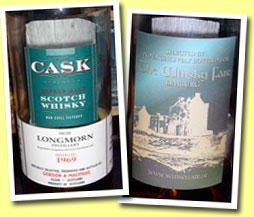
Front and back label
(or the other way round?) |
| Mouth:
it’s certainly not slow at the
attack, rather punchy, orangey and
spicy right at the first drops. A
tad more ‘brutal’ than
its bros at this stage but the general
profile is very similar. A little
more oak as well, but the rest is
all on crystallised oranges, acacia
honey, tangerines and kumquats. Let’s
see what happens with a few drops
of water: yes, that works, it got
rounder, creamier, with added hints
of ginger and salt. Finish: long,
on the same kinds of note. Very salty
tang in the aftertaste. Comments:
this beauty benefits from a few drops
of water on the palate, and then it
gets really in the same league as
its brothers. SGP:631 –
91 points. |
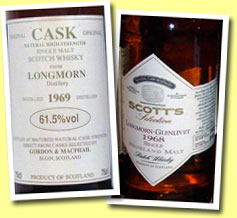 |
Longmorn
1969 (61.5%, G&M Cask, 75cl)
Colour: full gold. Nose: tell me about
a punchy one! Now, quite a few aromas
do manage to come through, such as
oranges, milk chocolate and wood smoke...
But water is needed for sure here.
With water: gets interestingly medicinal
(aspirin, embrocations) but also a
bit dusty and chalky. Some superb
notes of fresh limes, that is. Mouth
(neat): more sherry than in its bros
it seems, but it’s also a little
too harsh without water. |
| With
water: ah yes, now it’s truly
beautiful! All kinds of citrus fruits
just like in the DL, then walnuts
and pistachios, Chinese mushrooms
and dark toffee. Wonderful indeed.
Finish: long, displaying a blend of
all aforementioned flavours. Comments:
another one that really benefits from
a few drops of water. No reason to
rate it differently. SGP:543
– 91 points. |
| And
also Longmorn-Glenlivet
1968/2003 (61.3%, Scott’s Selection,
750ml, US)
A beautiful nose starting on ‘full
mint mode’ as well as citrons
and lemon balm, developing on verbena,
pu-erh tea and then Parma ham. Stunning.
Mouth: ditto. Very compact and nervous...
Then we have passion fruit... The
finish is very peppery and smoky.
Amazing that this one doesn’t
seem to need water at such high strength.
SGP:743 – 92 points.
|
MUSIC
– Recommended listening.
Fast, very fast, it's Lonnie
Brooks doing Got
Lucky Last Night;mp3. Jerry
Lee wouldn't disapprove, would he?
Please buy Lonnie Brooks' music!
|
 |
| |
May
7, 2008 |
|
|
| PETE
McPEAT AND JACK WASHBACK |
 |
TASTING
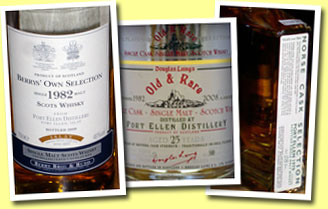
THREE RECENT PORT ELLENS |
| Port
Ellen 1982/2008 (46%, Berry Bros,
casks #2030-2035)
More new bottlings of that famous
malt whisky of which all stocks were
nearly exhausted ten years ago ;-),
but we won’t complain, many
are extremely good in our opinion...
Hope this one will be as good as the
stunning cask #2469 by the same bottler.
Colour: white wine – pale straw.
Nose: it seems that it’s one
of these ultra-austere PE’s,
all on wet stones, chalk, lime and
even aspirin, with almost no fruitness
whatsoever. It’s not very peaty
either, rather porridgy and lemony.
Not quite a Lowlander of course but
I believe it wouldn’t be too
easy to nail Islay’s south shore
when tasting this one blind. Interesting
notes of green curry and green pepper
as well. More peat comes through after
a while but it never quite gets ‘a
peat monster’. Different. Mouth:
starts amazingly lemony – almost
pure lime juice – and peppery,
with something a tad drying on your
tongue. A little cardboard? More sweetness
after that (apple compote) but again,
no big peat here. More something of
Talisker I think, which, of course,
isn’t bad news. Finish: medium
long, peppery and still a tad drying,
chalky, ‘mat’. Comments:
very good whisky but probably not
in the same league as cask #2469 from
last year. Sort of lacks ‘something’
I think. SGP:256 – 85
points. |
| Port
Ellen 25 yo 1982/2007 (57.5%, Douglas
Laing Platinum for PotStill Austria,
cask #3478, 512 bottles)
Colour: amber. Nose: this one starts
all on coffee and dark chocolate,
with a slightly subdued peat once
more but a very obvious smokiness.
More wood smoke that is... Then a
little orange liqueur, pepper, dried
Chinese mushrooms (the large black
ones), gunpowder, maybe a little rubber
(but I wouldn’t say this is
sulphury), prunes... Let’s see
what happens with a little water:
big notes of pencil shavings do arise,
as well as a little shoe polish and
pipe tobacco. A little drier. Mouth
(neat): it’s truly one of these
peat’n’sherry monsters,
with a huge attack on caramel and
pepper, maybe a tad cloying that is.
Oily mouth feel. Goes on with a continuous
fight between the thick sherry (orange
liqueur, prunes, chocolate, blackcurrant
jam) and the peaty and slightly bitter
pepper. Hot, quite immense but maybe
not too subtle... With water: drier,
more on coffee, soy sauce, salty liquorice
and balsamic vinegar. Finish: very
long, with a balance that’s
perfect now. Comments: nobody won
the fight. This is a rather extreme
– and sulphurless - sherried
Port Ellen. SGP:367 –
90 points. |
| Port
Ellen 28 yo 1979/2007 (53,6%, Norse
Cask Selection, cask #QW1311, 277
bottles)
Colour: pale straw. Nose: ah yes,
now we’re really talking! Big,
big smoke (coal and peat), with the
kind of austerity we’re really
fond of. Lemons, raw wool, wet limestone,
a little mint, oysters, lemon tonic,
ink, ashes and the rest of the gang...
It suddenly explodes after a while,
with big notes of fresh eucalyptus
leaves, new oak and pear peelings.
Not really sexy and maybe a tad ‘cerebral’,
but truly beautiful. For Port Ellen
exegetes? With water: a full plate
of oysters, with lemon, seaweed and
pepper and added notes of fresh almonds.
Less herbal and maybe more typical.
Mouth (neat): a little sweeter and
rounder than on the nose and more
resinous and herbal as well. Even
bigger notes of eucalyptus, pine resin
sweets, mint... And of course a lot
of pepper and peat. Excellent! With
water: it got more almondy but still
quite resinous. And very peppery.
Finish: rather interminable, with
a peaty backburn and also a little
salt. Comments: one of these sharp
Port Ellens that we like so much,
but that may put off lovers of sweet
and rounded whiskies. You’ve
been warned. SGP:158 –
92 points (and mange
tak, Carsten-H.) |
 |
|
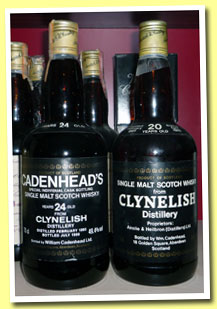
WANTED!
For
a friend (I swear he's not yours
truly) any of these two dumpy
Clynelishes. Namely the
24yo 1965/1989 at 49.4% or the 20yo
1965/1985 at 46%... Or any other
'brown dumpy, black label' Clynelish
you would own or know of.
You may contact us there,
thank you!
Signed:
the sheriff. |
| MUSIC
– Recommended listening.
Jazz: the graceful and badly missed
Susannah
McCorkle sings Love
walked in.mp3 with just a bass.
Delicious, isn't it? Please buy
Susannah's music... |
 |
| |
May
6, 2008 |
|
|
'CONCERT'
REVIEW by Nick Morgan
BRING ME THE HEAD OF
UBU ROI
Pere Ubu with
Gagarin and the Brothers Quay, Queen
Elizabeth Hall, London, April 25th,
2008. |
 |
This
isn’t a concert. It’s
a play, of sorts. It’s a performance.
At times it seems like a bloody fiasco.
But it’s David Thomas and Pere
Ubu, and you can therefore
be sure of one thing, it won’t
lack interest, provocation or humour.
What we’re watching is the second
of two performances of Mr Thomas’
adaptation of Alfred Jarry’s
controversial play, Ubu
Roi, renamed ‘Bring me the
head of Ubu Roi’. First performed
in 1896 the play provoked uproar from
its opening lines, “Merdre,
Merdre”, onwards. |
| It
was confrontational, absurd, and deeply
funny (three words which might well
apply, one could think, to the work
of Mr Thomas, an admirer of Jarry
from his youth). The absinthe-drinking
Jarry, of course, was also the founder
of the Pataphysics
movement, dedicated to “the
science of imaginary solutions’,
whose devotees (in addition to Mr
Thomas) include such luminaries as
Kevin Ayers and Robert Wyatt. It is,
of course, a piece of nonsense, just
like this evening. |
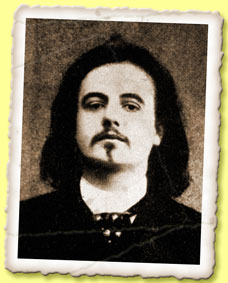
Alfred Jarry |
| The
performance ‘stars’ Thomas
as Pere Ubu, and former Communards
vocalist and noted jazz-singer Sarah
Jane Morris as Mere Ubu, The band,
and guest artist Gagarin,
perform the remainder of the roles
with greater or lesser degrees of
competence. The performance is sprinkled
with a number of songs ‘in the
Pere Ubu style’, whilst Gagarin
provides a richly-textured aural backdrop,
a counter to the visual environment
created by the Brothers Quay. |
| As
for the plot – well, I guess
it’s about greed and avarice
with not a shred of redemption in
sight, an uncomfortable mirror to
stand up against nineteenth, and for
that matter, twenty-first century
polite society. |
| The
stage is bare – the band are
squeezed in on the right hand side,
and whilst not performing Thomas and
Morris lounge on chairs on the left.
Thomas introduces each scene with
a short narrative of what is about
to unfold – an afterthought
following the first night (which in
Thomas’ words was also ‘a
bit of a shambles’) when it
became apparent that no one knew what
was going on. He’s getting more
and more like that grumpy and lovable
old uncle who comes to stay at Christmas,
gets drunk and generally disgraces
himself, and scandalises your parents.
His narrative voice, half exasperated,
half bored (“so many pieces
of paper, so little time” he
sighs as he struggles to find the
right sheet) sounds like a cross between
W C Fields and Sylvester
the Cat – I half expected
him to come out with "Sufferin’
succotash!". |
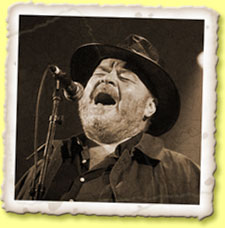
David Thomas |
| As
Ubu he’s a grotesque in his
now trademark raincoat (where is the
whippet I wonder?). As he takes his
position centre stage he’s accompanied
by electronic squelches, squeaks and
farts. And as the evening progresses
it becomes apparent that he’s
very fussy about his farts, stepping
out of character (or is he?) to berate
his band when they forget the farts,
or use the wrong ones – “I
want the fucking long farts. I told
you fuckers the long farts. Long farts!”.
These rages, a stratagem for covering
up flaws or glitches in the performance,
become more frequent, despairing and
entertaining as the evening goes on,
and as the tightly-knit spectacle
slowly unwinds. Towards the end Thomas
falls into his chair – “
I told them we’d never get this
fucking right and you know what, everyone
hates a know-it-all when he’s
fucking right”. |
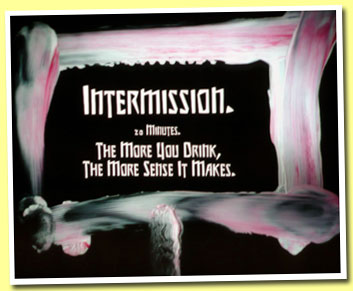 |
Together
Thomas and Morris manage to turn the
menacing, plotting, untrusting and
murderous Ubus into a slightly more
sinister version of Roald Dahl’s
The
Twits. They’re dark, but
never too dark (although certainly
too dark to take photographs). It’s
almost like pantomime without the
ghastly television ‘celebrities’,
a sort of Carry On Pataphysics, with
a slightly unnerving edge created
by the visuals and soundtrack. |
|
And believe me, for all the mistakes
it’s thoroughly engaging and
compelling. I’m not sure what
the audience expected, and was surprised
that so many left at the interval
– it’s David Thomas, what
on earth did they expect? Even some
of those who made it back couldn’t
stick it to the end, to Thomas’s
final jibe, “I spit on your
applause”. A shame. I’ve
rarely left a theatre feeling quite
as entertained. Merdre! - Nick
Morgan (intermission photograph by
Kate) |
Thank
you, Nick. Don't we all love David
Thomas, Alfred Jarry, Pataphysics,
Arrabal, Vian... And the rest? So
let's pay homage to all these great
persons with this brand new pataphysical
picture by an unknown fan of the Gidouille.
It's called "two bottles
of the very same and very multidimensional
single malt Scotch whisky missing
one single flavour and the bloody
opposite."
For our friends who may prefer
music, there isn't any (of course)
on Pere
Ubu's MySpace page. |
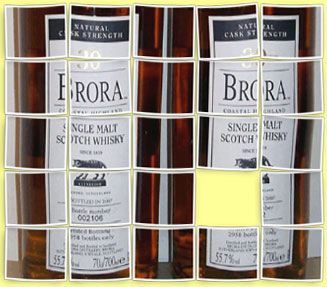 |
 |
TASTING
– TWO OLD GLENGLASSAUGH |
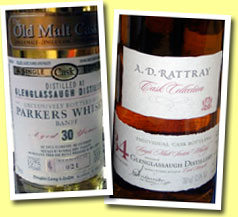
| Glenglassaugh
30 yo 1975/2006 (45.6%, Douglas Laing
OMC for Parkers Whisky, Ref. 2585,
206 bottles)
Colour: white wine – pale gold.
Nose: starts interestingly, on leaves
smoke (garden bonfire), wax polish
and soot and develops on vanilla crème,
leather and dark tobacco or shag (Gauloises).
Gets then more resinous, with hints
of putty and turpentine. Also barbecue,
burning charcoal and sausages. I like
this profile quite a lot, hope the
palate will be in the same vein. Mouth:
big, ‘wide’, candied and
orangey. A lot of orange marmalade,
honey and pepper, with something slightly
prickly (orange zests). Maybe not
immensely complex but it’s flawless
old whisky. Excellent spiciness. Finish:
very long, like some peppered orange
marmalade. Comments: very good whisky,
more complex on the nose than on the
palate. SGP:543 – 89
points. |
| Glenglassaugh
34 yo 1973/2008 (52%, Dewar Rattray,
cask #3776, 136 bottles)
Colour: gold. Nose: very, err,
‘different’. Big whiffs
of sour wood (moisture) and rancid
butter, which isn’t as disgusting
as it sounds, far from it. Also walnuts,
flor... Gets straighter after a few
minutes, more on oranges and marmalade
but also horse sweat and wet dog (sorry
again, dogs.) Funnily, the whole is
entertaining and pleasant, provided
you’re not only into clean whiskies.
Mouth: it’s much closer to the
DL now, very orangey and spicy, displaying
a rather simple but flawless profile.
Also honey, praline and caramel crème.
Orange drops. Absolutely no overwoodiness.
Finish: long, on caramelised oranges
and honey coated hazelnuts. Comments:
another one where the nose is much
more complex than the palate. A great
old whisky globally. SGP:553
– 88 points. |
| |
May
5 , 2008 |
|
|
 |
TASTING
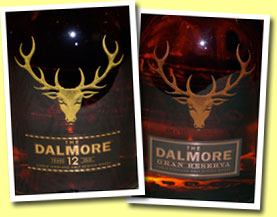
– THE NEW DALMORES (stags
ahoy!) |
| Dalmore
12 yo (40%, OB, 2008)
The proportion of sherry casks in
this new ‘12’ just went
up from 30% to 50%. Colour: dark gold.
Nose: starts all on coffee, roasted
nuts and blackcurrant jelly, with
good oomph despite the 40% vol. It’s
very malty as well, getting more and
more chocolaty over time, with also
a little smoke and the trademark notes
of orange marmalade. So far, so good.
Mouth: amazing how ‘nervous’
this one is despite the low ABV. All
on orange liqueur and milk chocolate
plus marmalade and spices (notes of
Chinese anise and cloves). Finish:
rather short but balanced. Grand-Marnier.
Comments: not the most complex of
all on the palate but I think it’s
better than the former version of
the 12 indeed. Good sippin’
whisky. SGP:531 – 83
points (up from 80). |
| Dalmore
‘Gran Reserva’ (40%, OB,
2008)
This is the former ‘Cigar malt’
– it seems that smoking is less
and less PC. 60% sherry and 40% bourbon.
Colour: dark gold. Nose: rather less
coffeeish and less malty than the
12 and much more on fruit jams, tamarind,
tobacco (funny how our mind works),
a little camphor, chocolate... getting
then earthier, almost mushroomy. Richer
and thicker than the twelve, also
smokier. Maybe a tad ‘obvious’,
or let’s say ‘pushy.’
Mouth: not big but creamy and pleasantly
orangey. Good maltiness. Liquorice
and tea. Lacks a little more texture.
Caramel. Finish: medium long, better
than ‘the end of the palate’,
more on dark chocolate and malt. Also
slightly salty/kirschy, which is ‘funny’
here. Comments: very good whisky but
I liked the 12 a little better. The
zing from a few extra-degrees –
like, three – would be welcome.
SGP:431 – 82 points. |
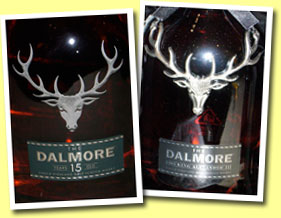
| Dalmore
15 yo (40%, OB, 2008)
100% matured in Mathusalem sherry
casks. Colour: dark gold (just the
same as its siblings – caramel?)
Nose: we’re frankly on chocolate
now, at least at first nosing. Gets
then more ‘secondary’
and complex, with hints of patchouli,
sandalwood, cigar box and rose jelly,
then lemonade, ginger tonic and orange
juice. Gets then more and more orangey,
somewhat lighter, but more elegant
than both the 12 and the GR, despite
the higher proportion of sherry casks
(which you don’t really feel
here). |
 |
| Great
notes of parsley come through after
ten minutes. Mouth: excellent attack,
soft but full, immediately subtler
than the 12 and GR. Oranges, ginger,
chocolate, hawthorn tea, chicory and
liquorice. Too bad the middle is slightly
weakish (the 40% again). Finish: medium
long, maltier and more coffeish, with
a slight smokiness. Comments: a very
good Dalmore. Again, I hope there’s
a version at 43% somewhere... SGP:431
– 85 points. |
| Dalmore
‘King Alexander III’ (40%,
OB, 2008)
A blend of 1/3 Haut-Marbuzet wine
casks (in case you don’t know,
Haut-Marbuzet is a very good cru bourgeois
from St. Estèphe), 1/3 sherry
and 1/3 bourbon. Colour: dark gold
(yet exactly the same colour!) Nose:
starts like a blend of all younger
versions, with both a ‘chocolaty
maltiness’ and a fresh ‘oranginess’
(my god!) Also more wood... A little
ginger, pink grapefruits, ripe kiwis,
vanilla custard, figs... It’s
also very slightly lactic. A tad less
clean than ‘the others’
and that may come from the Bordeaux
wine casks. Now, we like the generally
citrusy profile. Mouth: this is better,
albeit a tad weakish again. You know,
this ‘evanescent feeling of
dissatisfaction’. It’s
really a pity because the profile
is rather perfect, more coherent and
‘mingled’ than on the
nose. Oranges again, chocolate, cherries,
blackcurrants, macadamia nuts, a little
mint... Finish: drier and spicier,
in a very nice way. Excellent wood
extracts. Winey aftertaste, like if
you just had a bottle of... say, Haut-Marbuzet
(yeah, that was easy.) Comments: I
don’t want to insist too much,
but ‘this would certainly benefit
from a few more percents of alcohol.’
SGP:441 – 84 points. |
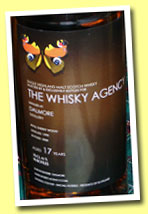 |
And
also Dalmore
17 yo 1990/2008 (46%, The Whisky Agency,
90 bottles)
A new series by the guys behind Limburg’s
Whisky Fair. Colour: gold. Nose: completely
different from the officials, even
if one can feel that it’s the
same distillery. Wilder, more phenolic,
waxier and more mineral. And much
fresher. Notes of cut grass, and then
the trademark orangey and chocolaty
notes. Hints of peanut butter. Mouth:
excellent attack, much more satisfying
than the OB’s at this stage.
Spicy chocolate, ginger and liquorice.
Finish: long and gingery, with notes
of candy sugar. Comments: less civilised
than the OB’s but more satisfying
in a sense. Yes we like wildness in
our dram (wot?) SGP:642 –
87 points. |
| PETE
McPEAT AND JACK WASHBACK |
 |
WHISKY
BOOKS - This new
book about Ardbeg looks
very promising. It's called 'Ardbeg
A Peaty Provenance' and ou can admire
sample pages there.
While
I'm at it, may I recommend you the
excellent 'first refill edition'
of Pär Caldenby's
book 'Enjoying Malt Whisky?' It's
very complete and easy - and fun
- to read and if you had to own
only one book about malt, you could
well pick this one. It's available
at various places, such as Royal
Mile Whiskies or The
Whisky Exchange. |
| MUSIC
– Recommended listening.
The very sweet actress Emmanuelle
Seigner (remember Polanski's
Frantic?) sings Sing
sing.mp3 with the band Ultra Orange.
Please buy Miss Seigner's music, the
whole album is very good (even if
she sometimes sounds like both Nico
and Cherry Vanilla.) Oh, and the clip
is here. |
 |
| |
May
3 , 2008 |
|
|
 |
WE
ARE BACK! and firing
on all cylinders. Thanks for having
been patient, and thanks for all
your very kind words in Limburg
or elsewhere.
PS:
we're still way behind with our
emails - not sure we answered all
that were sent to us in 2007, actually.
Deepest apologies. |
BREAKING
NEWS!
TOP SECRET SCOTTISH
INNOVATION BREAKTHROUGH
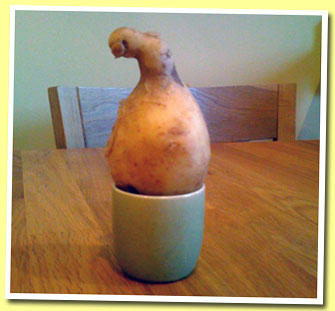
It's
taken years to perfect but easy to
use. Soak for an hour and then microwave
- the self- fermenting pot-still
potato will produce an egg-cup
full of 58 proof spirit.
Neat eh? |
 |
| CONCERT
REVIEW by Nick Morgan |
 |
BILLY BRAGG
The Barbican
London
April 23rd 2008 |
| It’s
St
George’s Day. You know,
England’s own Patron Saint (well,
not really our own, as he’s
also Patron Saint of Aragon, Catalonia,
Ethiopia, Georgia, Greece, Palestine,
Portugal and Russia, and, amongst
others, the city of Moscow). As far
as anyone can tell he was Turkish,
a warrior who converted to Christianity
and was martyred for refusing to persecute
his co-religionists. He had a tough
time: “stretched out on the
rack and ripped to shreds with flesh
hooks, harnessed to machines that
drew him apart, and then beaten, after
which salt was poured into his wounds,
which were rubbed with a haircloth
… then pressed into a box pierced
with nails, impaled on sharp stakes,
plunged into boiling water …
his head crushed by a hammer …”,
and that was just the start. He died,
legend has it, on 23rd April. He also
of course, killed the dragon, and
thus gained the reputation of a protector
which lives on to this day. And at
Prime Minister Gordon Brown’s
request, England is bedecked in red
and white flags, spontaneous street
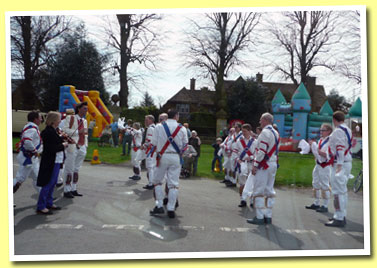
parties abound, Morris Dancers, Costermongers
and Pearly Kings and Queens dance
through the streets arm-in-arm like
a nightmare scene from a Lionel Bart
musical, and it’s Roast Beef
and Cornish Pasties for lunch. |
|
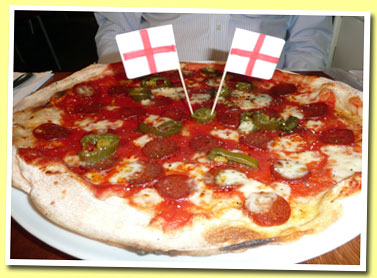
They’ve even joined in at
Don Corleone’s, the little
Mom and Pop pizza place which we
patronise prior to our visits to
the Barbican. The extra piquant
Dragon’s Breath pizza is a
revelation. It’s Shakespeare’s
birthday too, the famous Baird of
Stratford upon Avon, but I notice
their special Big Willy Gugliagones
aren’t moving too fast. |
 |
| We’re
out on the town in our red and white
plastic
bowler hats to celebrate St George
with England’s own rocking patriot,
the Baird of Barking, Billy
Bragg, who’s been
much concerned with Englishness over
the past few years, having read a
couple of books about it, and written
one - The Progressive Patriot - of
his own. You may recall that a lot
of this is connected with Bill’s
total misunderstanding of the causes,
events and historiography of the English
Revolution, and his willingness to
‘tokenise’ groups such
as the Diggers and Levellers as icons
for his particular brand of soft and
sentimental socialism. But he’s
not too concerned with that seventeenth
century shtick tonight – his
mission, he tells us, is to reclaim
St George and the idea of Englishness
from the clutches of right-wing extremists
such as the British National Party,
and to get the English to reassess
nationalist politics in the light
of the success of our neighbours in
Scotland. “It’s all about
having a sense of place” says
Billy. |
 |
|
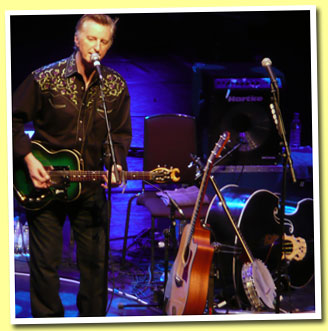
He
begins the evening with Leon
Rosselson’s ‘World
turned upside down’, and then
leads the audience in ‘Jerusalem’
(“You are so powerful”
Bragg tells us) before being joined
by the first of his guests. It’s
the very talented, ‘though sadly
giggly and gauche Rachel
Unthank and the Winterset from
Northumbria, who delight the audience
with their singing and electric clog-dancing,
and perform a charming and quite excellent
cover of Robert Wyatt’s ‘Sea
song’.“That’s really
powerful” says Billy, as he
joins them as special guest. |
| Tom
Clarke follows, a Coventry patriot
from The
Enemy who appears to have watched
too many Paul Weller videos, and sings
a pretty ill-judged song (“I
only wrote this yesterday”)
about the distressing murder
of Sophie Lancaster. “How
powerful is that?” asks Billy,
who joins him as special guest. And
finally from the left of the field
Kitty,
Daisy and Lewis, a brother and
sisters (with Mom on double bass and
Dad playing acoustic guitar and having
the time of his life) rockabilly,
skiffle, rhythm and blues and swing
combo from London’s Camden Town.
They rush though about ten songs,
changing instruments at bewildering
speed (and not always playing them
too well) and totally befuddle the
audience when they play a Hawaiian
tune. “What’s Honolulu
got to do with England?” shouts
a besandled and bearded Guardian-hugging
folk traditionalist, giving Bragg
a platform for what becomes an evening
long diatribe on inclusiveness. We
also get a useful lesson on the Hawaiian
flag. “That’s just so
powerful” says special-guest
Bragg. |
| Bragg’s
set is a mixture of some nicely played
and sung tunes, some patronising tub-thumping
(“Why does he always fucking
preach to the converted?” asks
a frustrated fan at the end, hands
still clamped to his ears), and a
long rant about the need for a British
Bill of Rights. There’s a nice
Dick Gaughan song, ‘ ‘Both
sides between’, and some old
favourites like ‘Sexuality’,
and inevitably stuff from his 2002,
England Half English album, including
the title track, a reworking of ‘John
Barleycorn’, and ‘Take
down the Union Jack’, which
borrows heavily from Rudyard Kipling.
He also plays songs like ‘Keep
the faith’ from his well received
new album Mr Love and Justice. There’s
the anti-war ‘Farm boy’
and Bragg’s reworking of ‘The
hard times of old England’,
and ‘Oh Freedom’. This
is followed by ‘Old Clash fan
fight song’ which leads Billy
into a long reminiscence about the
start of the Rock Against Racism movement
thirty years ago, and its influence
on his then formulating politics.
It’s another unnecessary and
self-focussed stream of consciousness;
it doesn’t seem to have occurred
to Bragg, for example, that anyone
else might have attended that famous
march through London on 30th April
1978 or seen the famous Clash gig
that followed in Hackney’s Victoria
Park. In this, as in many things,
Billy is a tad myopic. He ends the
set with ‘There is power in
a union’. “Are there any
teachers in tonight?” he asks.
They’re striking the following
day, putting over a million children
out on the streets. That, as Billy
might have said, is really powerful. |
|
Finally he lets the audience sing
‘New England’, which they
do, badly. We’re then asked
to hold up our programmes to make
a cross of St George for a photograph,
and finally, and most bizarrely, encouraged
to join all the artists in singing
the American spiritual, ‘Swing
low sweet chariot’, much brutalised
of late by braying English rugby supporters.
Confused? Well I was. And I’m
not sure that Billy wasn’t too,
as I was no clearer on what this thing
called Englishness was or is, and
I don’t think he was either.
So we left it at that, and after a
couple of pints of Fosters and Kronenbourg
down the George and Dragon, headed
for the St George Kebab and Sushi
House for a carry-out chicken tikka
with chop suey, which we washed down
with some of Scotland’s famous
midnight wine. Very patriotic, very
powerful. - Nick Morgan (photographs
by Kate) |
| TASTING
– OLD AND NEW SHERRIED BLADNOCHS
H2H |
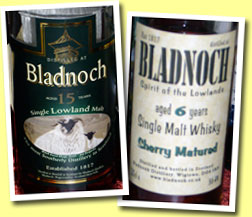 |
Bladnoch
15 yo (55%, OB, sherry butt #2617)
Colour: gold. Nose: relatively discrete
at very first sniffs, with hints of
sherry and hints of lemon but not
much else. Let’s give it time...
Right, more lemon indeed (pure lemon
juice) as well as cut grass, but this
one may need water. So, with water:
it got grassier and, quite curiously,
more austere. Hints of clams and kelp
– sprinkled with lemon. Lemon
grass (not lemongrass). Improves over
time, getting nicely mineral and even
ashy. |
| Mouth
(neat): ‘pure sherried lemon’.
Powerful but maybe a tad monodimensional.
Vanilla and lemon fudges. With water:
wow, now it got excellent! Lemons
of all kinds, crystallised, candied,
squeezed, dried, barbecued –
not! Finish: long, clean, lemony and
candied. Comments: we think this one
really needs time + water, but then
it gets really superb. SGP:451
– 78 points (without water)
and 87 points with
water (yeah, really). |
|
Bladnoch
6 yo (56.4%, OB, sherry matured, 20cl)
We believe this is the first bottling
of the new owners’ spirit. Colour:
gold. Nose: one thousand times more
expressive than the 15 at first nosing.
Big notes of caramel crème,
vanilla fudge, warm butter, ginger
and soft curry that remind me of Glenmorangie’s
experiments with new oak. Weird? Or
is it me? The citrusy notes arise
only after a few minutes, together
with now obvious sherry notes. Gets
more and more vinous I must say, let’s
see what happens with water. With
water (right!): more of the same.
No changes whatsoever as far as the
profile is concerned. Mouth (neat):
exactly like it was on the nose when
naked. Ginger, vanilla and caramel
crème. With water: this time
it got more complex, with the same
fudgy/oaky/spicy notes again but also
a slight ‘lemoniness’.
Finish: long, compact, on the same
notes again, plus a little salt. More
lemon as well. Comments: we haven’t
tried many very young Bladnochs from
earlier distillations so it’s
hard to make comparisons, but it seems
that Bladnoch’s new spirit is
quite different from what it used
to be. Maybe less on the citrusy side,
whilst it became a ‘bigger’
spirit. Less Lowlands, more Highlands?
Now, this was obviously a very active
cask, so let’s not draw conclusions
too fast. SGP:440 –
82 points. |
Check
the index of all entries:
Whisky
Music
Nick's Concert
Reviews
|
|
|
|
|
| |
Best
malts I had these weeks - 90+
points only - alphabetical:
Balvenie
31 yo 1973/2004 (49.7%,
OB, cask #9214, 213 bottles)
Caol
Ila 23 yo 1984/2008 'Local AI' (57.2%,
The Nectar, Daily Dram, 198 bottles)
Longmorn-Glenlivet
1968/2003 (61.3%, Scott’s Selection,
750ml, US)
Longmorn
1969 (61.5%, G&M Cask, 75cl)
Longmorn
1969/2000 (53.8%, Castle Collection,
VA.MA., Italy)
Longmorn
31 yo 1969/2001 (45.65%, Douglas Laing
OMC, 210 bottles)
Longmorn
1969/2008 (54.6%, Gordon & MacPhail
Cask for The Whisky Fair)
Macduff
38 yo 1967/2005 (50.8%, Jack Wieber,
Old Train, cask #619, 204 bottles)
Port
Ellen 25 yo 1982/2007 (57.5%, Douglas
Laing Platinum for PotStill Austria, cask #3478,
512 bottles)
Port
Ellen 28 yo 1979/2007 (53,6%, Norse
Cask Selection, cask #QW1311, 277 bottles)


|
| |
|
|